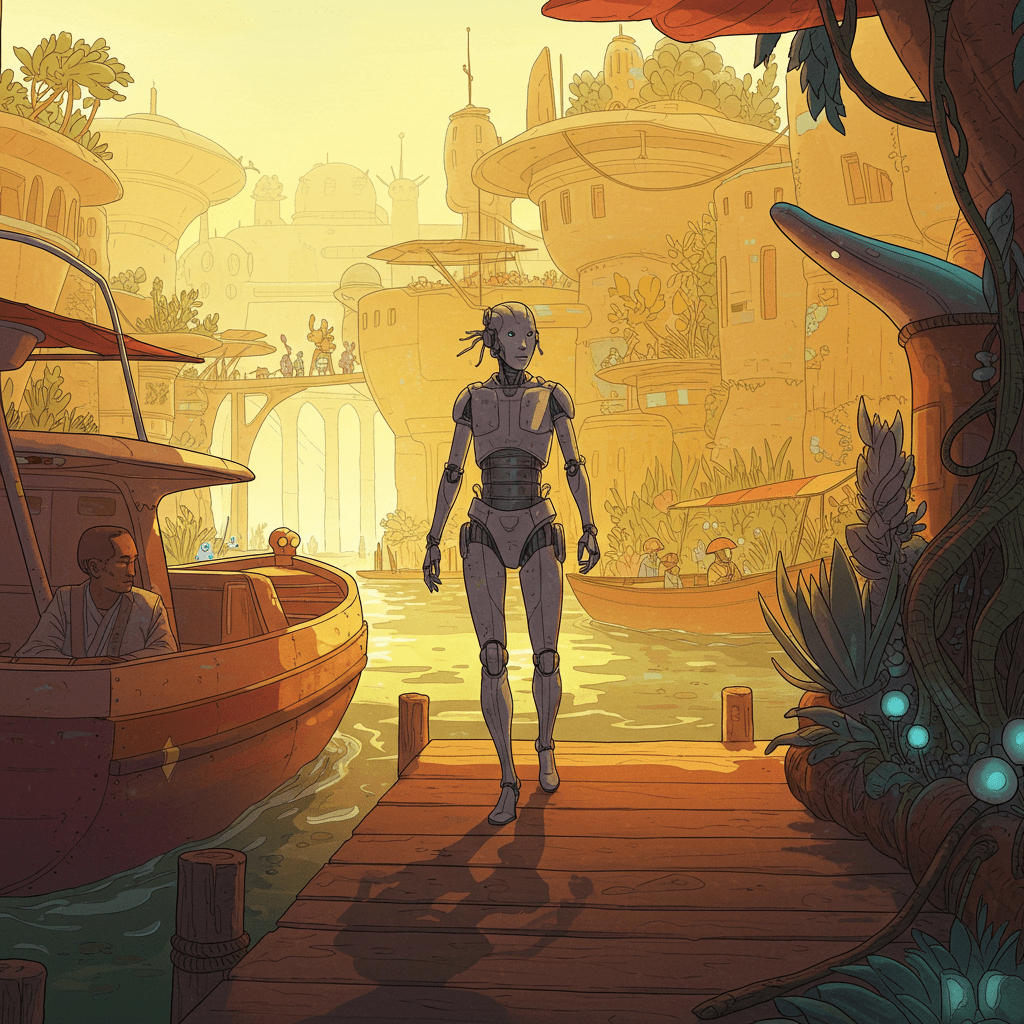
Today offers a deep dive into the cultural and psychological implications of AI and how we choose to use it, and why this is a defining moment for humanity. With 3 billion cellphones equipped with AI this marks “the world’s biggest immigration event” of a non-biological superintelligence entering into everyone’s homes. What’s next?
Yuval Noah Harari and Asa Raskin explore the implications of AI development and its rapid acceleration, addressing societal risks and ethical considerations.
The AI Pause Letter
A letter calling for a pause in AI development was discussed, emphasizing that it aimed to slow down advancements in AI models like GPT-4. Despite its intent, the letter did not stop progress, highlighting the competitive nature of technology advancement among corporations and nations.
Speed of Change
Yuval Noah Harari noted that humanity is experiencing unprecedented change, with AI evolving at an inorganic speed, outpacing human adaptability. He argued that while AI has potential benefits, the speed of its development poses significant challenges for society.
Trust Issues
The conversation highlighted a paradox where AI developers express distrust towards humans while believing in the reliability of AI. Asa Raskin emphasized the need for trust not just in AI but also in human relationships, using historical examples to illustrate the dangers of misplaced trust.
Balancing Risks and Benefits
Both speakers stressed the importance of balancing the potential benefits of AI with its risks, emphasizing that the focus should be on whether risks could undermine societal foundations. They suggested that past technological advancements often resulted in unforeseen negative consequences.
Historical Comparisons
Harari provided historical context, comparing Silicon Valley’s ambition to re-engineer society with past revolutions. He underscored that historical technological advancements often led to harmful outcomes and that we must consider the societal impact of AI development.
Regulation and Governance
A discussion arose about the need for regulations and institutions to manage AI, with Harari arguing for transparent disclosure when interacting with AI. He emphasized the importance of holding companies accountable for their algorithms’ impacts on society.
Future of AI and Humanity
The potential for AI to replace human cognitive functions raised concerns. Both speakers advocated for investing in human capacities alongside AI development to ensure humans retain agency and control over their decision-making processes.
Empathy and AI
The speakers discussed the implications of creating empathetic AI. While AI could mimic empathy, it lacks genuine human emotions, which could lead to challenges in maintaining meaningful human relationships.
In Conclusion
The conversation concluded with a call for thoughtful governance, societal reflection on AI’s trajectory, and the importance of preserving human agency in an increasingly automated world. The participants emphasized the need to balance technological advancement with ethical considerations and communal trust.
Quote of the Day
“Yesterday I was clever, so I wanted to change the world. Today I am wise, so I am changing myself.” – Rumi
A Brief History of AI
AI’s journey began with Alan Turing’s foundational work on computation and his idea of the Turing Test to evaluate machine intelligence. In 1956, the Dartmouth Workshop formally launched AI as a field, focusing on symbolic reasoning with early programs like Logic Theorist. The 1958 perceptron model marked the start of neural networks, later revolutionized by backpropagation in the 1980s. Probabilistic methods, like Bayesian networks, advanced reasoning under uncertainty, while breakthroughs in reinforcement learning emerged with systems like TD-Gammon. Deep learning took off with Yann LeCun’s CNNs in the 1980s and AlexNet’s 2012 ImageNet success, powered by GPUs. The 2017 Transformer architecture led to today’s powerful language models like GPT. Reinforcement learning matured with DeepMind’s AlphaGo, and generative AI like GANs expanded AI’s creative potential. Alongside these, tools like TensorFlow and ethical frameworks have driven modern AI’s accessibility and responsibility, making it a transformative force across disciplines.
 Light Being ॐ
Leave a comment