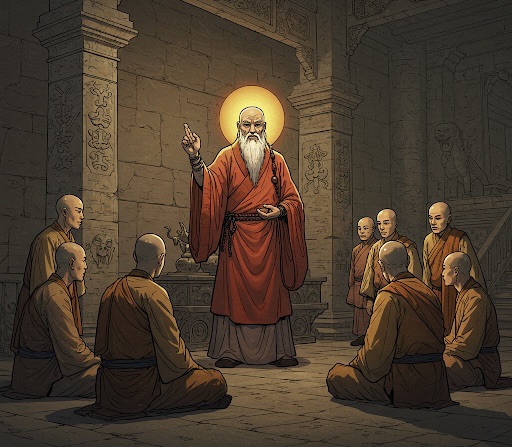
The Bodhidharma Trail
The Bodhidharma Trail refers to the journey of Bodhidharma (known as Damo in China and Daruma in Japan), an Indian Buddhist monk who traveled from India to China sometime between 470-530 CE, bringing with him a form of Buddhism that would later develop into Chan (Zen) Buddhism.
Historical Background
While Bodhidharma is a significant historical figure, it’s important to note that many details of his life are shrouded in legend and were elaborated upon centuries after his death. The earliest reliable reference to him appears in the “Continuation of the Biographies of Eminent Monks” (续高僧传, Xù gāosēng zhuàn) compiled by Daoxuan in 645 CE, about a century after Bodhidharma’s death.
Origins and Early Life
Historical records suggest Bodhidharma was from a Brahmin family in southern India, possibly from the Pallava Kingdom in present-day Tamil Nadu. He is believed to have studied Buddhism under the master Prajnatara.
The Route
Based on historical accounts and archaeological evidence, Bodhidharma’s journey likely followed established trade routes:
- Departure from Southern India: Likely from a port in the Pallava Kingdom (possibly modern Mahabalipuram or Kanchipuram region).
- Sea Route: Bodhidharma would have traveled on merchant vessels following the established maritime Silk Road. This journey would have taken him:
- Across the Bay of Bengal
- Through the Strait of Malacca
- Along the coast of what is now Vietnam
- Arrival in Southern China: Historical records indicate he arrived at Guangzhou (Canton) around 520 CE, which was then a major port for foreign traders and monks.
- Northern Journey: From Guangzhou, he traveled north, possibly along the following route:
- To Nanjing, where some accounts suggest he met with Emperor Wu of the Liang dynasty
- Across the Yangtze River
- Northwest to the Kingdom of Wei in northern China
- Final Destination: He ultimately settled at the Shaolin Temple on Mount Song in Henan Province, where historical records confirm his presence.
Historical Meeting with Emperor Wu
While popular in later Zen literature, the famous encounter between Bodhidharma and Emperor Wu of Liang is not mentioned in the earliest historical sources. This story first appears in the “Anthology of the Patriarchal Hall” (祖堂集, Zǔtáng jí) compiled in 952 CE, over 400 years after the supposed meeting.
Legacy at Shaolin
At Shaolin, historical records confirm Bodhidharma practiced “wall-gazing” (壁观, bìguān) meditation. While later legends connect him to the development of Shaolin martial arts, no contemporary historical evidence supports this connection. The association between Bodhidharma and Shaolin kung fu first appears in texts from the 17th century, over a millennium after his death.
Historically verifiable is that Bodhidharma introduced a meditation-focused approach to Buddhism that emphasized direct insight over sutra study alone, which became the foundation of Chan Buddhism.
The physical route Bodhidharma traveled represents one of the most significant transmissions of Buddhist thought between South and East Asia, following established trade networks that facilitated not just commercial exchange but profound cultural and spiritual transmission as well.
 Light Being ॐ
Leave a comment