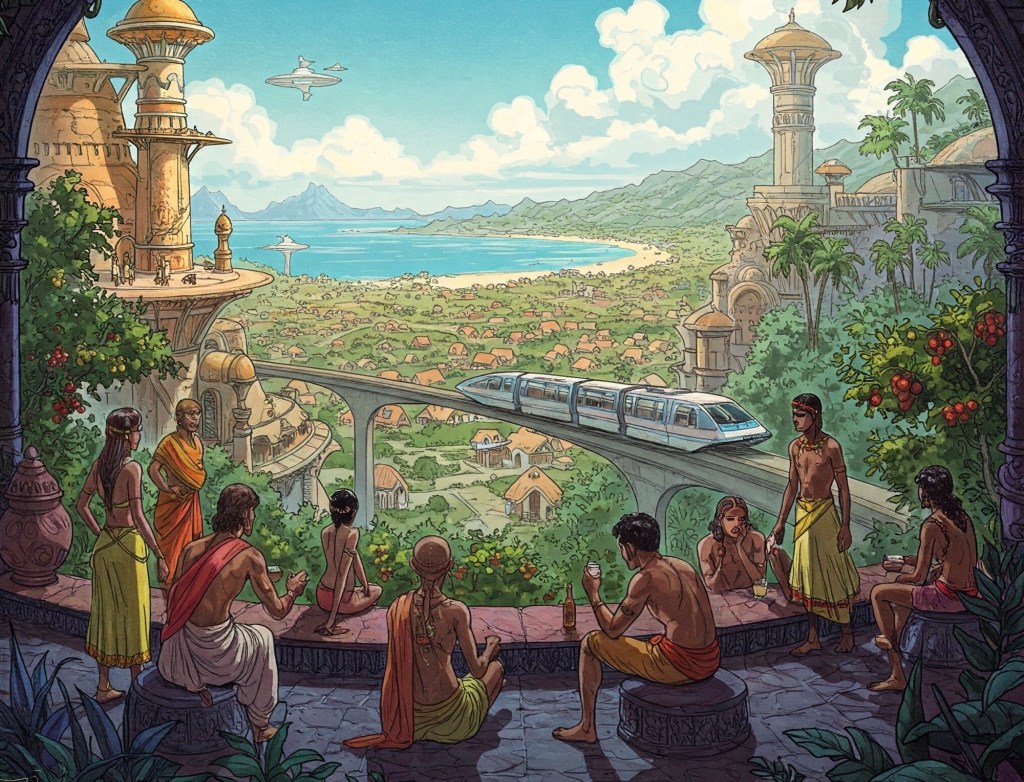
The modern psyche is a fascinating paradox, oscillating between a misplaced fear and an almost blind adoration of technology.
This duality reflects a deep-seated longing for both control and connection in a world increasingly perceived as fragmented.
On one hand, the rapid advancement of technology, particularly in the context of “smart cities,” triggers anxieties about surveillance, automation, and the erosion of human connection.
On the other hand, there’s an almost utopian belief that technology can solve all our problems, from climate change to social inequality. This oscillation is a symptom of a deeper disconnect, a sense of alienation from both the natural world and our own intrinsic humanity.
Returning to wholeness, therefore, necessitates a re-evaluation of our relationship with technology and a rediscovery of the power of community through interdependence.
This is where the concept of an “Intentional Community Eco-Village Network” emerges as a powerful alternative.
It acknowledges the potential of technology to enhance our lives while prioritizing human connection and ecological sustainability.
Instead of a centralized, top-down “smart city,” eco-villages emphasize decentralized, community-driven solutions.
Eco-villages leverage technology for efficient resource management, renewable energy systems, and communication, but always within a framework of shared values and mutual support.
Fears of technological overreach are mitigated by community oversight and a focus on transparency, while the potential for innovation is harnessed to create sustainable and resilient living systems.
The core principle of eco-villages is interdependence. This means recognizing that our well-being is inextricably linked to the well-being of others and the health of the planet.
Shared resources, collaborative decision-making, and mutual aid create a strong sense of belonging and purpose.
This contrasts sharply with the individualistic ethos of many urban environments, where isolation and competition can lead to feelings of alienation and anxiety.
By fostering a culture of cooperation and shared responsibility, eco-villages address the fundamental human need for connection and belonging.
Moreover, eco-villages often prioritize a close relationship with nature, incorporating practices like permaculture, organic farming, and natural building.
This connection to the land provides a grounding influence, helping to counteract the disorienting effects of rapid technological change.
By integrating technology with ecological principles and community values, eco-villages offer a path towards a more balanced and fulfilling future. They demonstrate that technology can be a tool for empowerment and connection, rather than a source of fear and alienation, when it is used in service of a shared vision of wholeness and interdependence.
This return to wholeness is not a rejection of technology or industrialized civilization, but a re-contextualization, allowing it to serve the human spirit.
The Purpose of Spirituality in the Context of Industry and Community
At the heart of transforming our cities and our lives rests the development of a profound spiritual connection.
This isn’t about adhering to a specific dogma or indulging in fleeting trends; it’s about recognizing the inherent interconnectedness of all things and cultivating a deep sense of purpose and meaning.
Community, then, becomes the fertile ground where this spirituality can flourish, a space for shared exploration and collective growth.
This spirituality acknowledges the embodied nature of human experience.
We are not simply minds floating in a void; we are physical beings, deeply intertwined with the natural world.
Our bodies are temples, our senses gateways to understanding. It’s about honoring that embodied experience, recognizing the sacredness of the present moment, and finding joy in the simple act of being alive.
In a rapidly changing world, this spiritual connection becomes our anchor, our compass. It’s about cultivating resilience, not through rigid adherence to old ways, but through a flexible and open-hearted approach to life.
It’s about seeing challenges not as obstacles, but as opportunities for growth and transformation. It’s about cultivating the ability to see the potential for good in every situation.
Spirituality extends far beyond the confines of religious institutions or the allure of mystical objects.
While these can be valid expressions of spiritual seeking, true spirituality permeates every aspect of our lives.
It informs our personal relationships, guiding us towards compassion and understanding. It shapes our approach to health, encouraging us to cultivate balance and well-being.
It guides our career choices, inspiring us to pursue work that aligns with our values and contributes to the greater good.
This integrated spirituality extends into our social interactions, a skillset of fostering a sense of belonging and community that we take with us and share.
It influences our engagement with the scientific world, encouraging us to explore the mysteries of the universe with awe and wonder.
It shapes our approach to institutional and industrial systems, inspiring us to create structures that are just, equitable, and sustainable.
Community becomes the crucible for this transformative spirituality.
It’s a space where we can share our experiences, learn from each other, and support each other on our spiritual journeys.
It’s a place where we can cultivate empathy, compassion, and a sense of shared purpose.
In community, we can collectively explore the deeper questions of existence, grapple with the challenges of our time, and co-create a more meaningful and fulfilling future.
We can build a culture of care, where everyone feels seen, heard, and valued.
Developing a spiritual connection, and cultivating community as a space for that, is not a passive endeavor.
It requires conscious effort, ongoing practice, and a willingness to embrace vulnerability.
It’s about cultivating a deep sense of inner peace, while actively engaging with the world around us.
It’s about finding the sacred in the ordinary, and recognizing the extraordinary potential that lies within each of us.
This transformation is not a destination, but a continuous journey, a process of becoming more fully human.
Cultivating a Culture of Connection
Deep human connection stands as the foundational principle behind the intentional community movement, yet its wisdom extends far beyond eco-villages and alternative living arrangements. At its core, this philosophy recognizes that meaningful bonds between people represent our most valuable resource – one that can be cultivated anywhere we find ourselves. The practice begins with presence, with truly seeing those around us and creating space for authentic interaction amidst our busy lives. Small actions build this culture: establishing regular gatherings where devices are set aside, creating physical spaces designed for spontaneous conversation, and inviting vulnerability through shared meals or collaborative projects. Technology need not stand opposed to connection when chosen thoughtfully; simple digital tools can facilitate real-world gathering rather than replacing it. The beauty of cultivating connection lies in its adaptability – whether in urban apartments, suburban neighborhoods, or rural homesteads, we can intentionally design our daily rhythms to prioritize human relationship. This approach recognizes that resilience in times of challenge comes primarily through our interdependence, not our individual resources. By nurturing connections wherever we are, we weave a fabric of support that extends beyond immediate community boundaries. The intentional community movement reminds us that when connection becomes our guiding principle, we naturally challenge systems that isolate us and begin creating alternatives that honor our deeply social nature. This culture of connection doesn’t require dramatic lifestyle changes but rather a shift in perspective – seeing relationship-building not as a luxury or distraction but as the essential foundation upon which all meaningful change is built.
Addressing the Systemic Root of Shared Problems, Connecting the Dots
The urgency of our times demands more than intellectual understanding; it requires a visceral, emotional awakening.
The accelerating climate crisis, with its tangible threats of extreme weather and ecosystem collapse, isn’t just a scientific prediction; it’s a looming reality that evokes primal fear and a deep anxiety for the legacy we leave behind.
This fear, this anxiety, should be a catalyst, a fire that ignites immediate and radical action, pushing us beyond incremental change toward a fundamental shift in how we live.
Simultaneously, the insidious rise of social isolation, a pandemic of loneliness, underscores our fundamental human need for connection.
Studies reveal its devastating impact on mental and physical health, but it’s the raw, aching feeling of loneliness itself that resonates most deeply.
We yearn for belonging, for meaningful relationships, and community offers the sanctuary we desperately need.
The mental health crisis, with its soaring rates of depression and burnout, particularly among our youth, speaks to a profound spiritual and emotional void.
The weight of despair, the feeling of being overwhelmed, is a heavy burden to bear.
We need spaces for healing, for emotional support, for spiritual grounding, and community offers a refuge from the storm.
Economic inequality, with its widening chasm between the rich and poor, breeds social unrest and political instability.
But beyond the statistics, it’s the raw injustice of it all, the feeling of being trapped in a system that favors the few, that ignites a deep sense of resentment and despair.
Community-based economies and resource sharing offer a tangible path toward greater equity and justice.
The irreversible loss of biodiversity, the alarming rate of species extinction, is a tragedy that cuts to the core of our connection to the living world.
It’s not just about losing abstract concepts; it’s about the grief of losing the natural world, the deep sense of disconnection from the living Earth.
This grief should awaken a profound sense of responsibility, compelling us to reconnect with nature, restore ecosystems, and live in harmony with the planet.
The rising anxiety among children about the future is a stark reminder of our responsibility.
Their fear echoes our own, amplified by their innocence. The thought of them inheriting a broken world should break our hearts and ignite a fierce determination to create a better future.
We owe them a legacy of hope, resilience, and connection.
Finally, the rapid advancement of AI and automation, while promising technological progress, also brings the fear of job displacement and economic uncertainty.
This anxiety is not just about losing a paycheck; it’s about the fear of losing purpose and identity in a rapidly changing world. We must create community-based support structures and find new ways to find meaning outside of traditional jobs.
These facts, when truly felt, become more than just data points; they become a call to action.
They remind us that we’re not just facing abstract problems, but real, urgent threats to our well-being and the well-being of future generations.
They highlight the urgent necessity for a shift towards a more integrated, spiritual, and community-driven way of life, a shift that is not just desirable, but essential for our survival and flourishing.
Divesting from the Petrodollar, Post-Capitalism Market Dynamics
Designing a post-capitalist system that balances individual effort with collective goals requires a nuanced approach, drawing lessons from the successes and failures of past economic models.
We acknowledge that capitalism, despite its flaws, has driven innovation and wealth creation.
However, its tendency to prioritize profit over people and the planet has led to significant social and ecological externalities.
The classic communism-capitalism duality presented a false choice.
Communism, with its emphasis on centralized planning and collective ownership, often stifled individual initiative and led to economic stagnation.
Socialism, in its various forms, offers a middle ground, emphasizing social welfare and public ownership of key sectors. However, it can also lead to bureaucratic inefficiencies and a lack of innovation.
A more effective post-capitalist system would incorporate elements of both market mechanisms and social responsibility.
It would reward individual effort and innovation, but within a framework that prioritizes human rights and ecological sustainability.
This requires a fundamental shift in how we define “value.” We must move beyond a narrow focus on financial profit and incorporate social and environmental costs into our economic calculations.
De-growth and circular economies play crucial roles in this transition. De-growth challenges the assumption that endless economic growth is necessary or desirable.
It advocates for a shift towards a more sustainable and equitable economy that prioritizes well-being over consumption.
Circular economies, on the other hand, emphasize closed-loop systems that minimize waste and maximize resource efficiency.
Real wealth and growth lie not in the accumulation of material possessions, but in the cultivation of human potential and the restoration of ecological health.
Opportunities exist in renewable energy, sustainable agriculture, ecological restoration, and community-based enterprises.
These sectors offer the potential for both economic prosperity and social and environmental well-being.
Divesting from the petrodollar energy-banking system is a critical step towards a more sustainable and equitable future.
This system, based on the dominance of fossil fuels and speculative finance, has fueled environmental destruction and economic instability.
A shift towards a new monetary system, based on a more accurate form of energy calculation, would incentivize sustainable energy production and resource use.
Better accounting, financially and in terms of resources, is paramount.
We need transparent and accountable systems that track the true costs of production and consumption.
This includes incorporating ecological footprints, social impact assessments, and life-cycle analyses into our economic decision-making.
A zero-waste society is an achievable goal, drawing inspiration from the wisdom of indigenous peoples.
Their traditional practices of resource management and community-based living offer valuable lessons for building sustainable and resilient societies.
We must learn to live in harmony with nature, respecting the limits of our planet.
This new system would involve a blend of market mechanisms, social safety nets, and community-based initiatives.
It would empower individuals to pursue their passions and contribute to the collective good, while ensuring that everyone has access to the basic necessities of life.
It would be a system that prioritizes well-being, sustainability, and social justice, creating an equitable and fulfilling life for all.
Shifting Gears to the Practical Use of Resources
When comparing eco-village networks and smart cities from the perspectives of efficiency, resource use, finance, and resilience, eco-villages present several distinct advantages.
Efficiency and Resource Use:
- Decentralized Systems:
- Eco-villages often prioritize decentralized systems for energy, water, and waste management. This means localized renewable energy generation (solar, wind), rainwater harvesting, and composting, reducing reliance on large, centralized infrastructure that can be inefficient and vulnerable.
- Smart cities, while aiming for efficiency, often rely on complex, centralized systems that can be resource-intensive to build and maintain.
- Localized Food Production:
- Eco-villages frequently incorporate permaculture and organic farming, producing food locally. This minimizes transportation costs and environmental impact, and enhances food security.
- Smart cities, while they may promote urban agriculture, often rely on food transported from distant locations.
- Reduced Consumption:
- The ethos of eco-villages often emphasizes mindful consumption and a circular economy, reducing waste and resource depletion.
- Smart cities, while they may promote efficiency, can also inadvertently encourage increased consumption through technological conveniences.
Financial Standpoint: - Lower Infrastructure Costs:
- Eco-villages often utilize natural building materials and community-based construction, reducing infrastructure costs compared to the high-tech infrastructure required for smart cities.
- Smart city development requires massive capital investment in technology and infrastructure, often relying on public-private partnerships that can lead to increased debt.
- Localized Economies:
- Eco-villages often foster localized economies with barter systems, community currencies, and shared resources, enhancing financial resilience.
- Smart cities are typically integrated into the global economy, making them vulnerable to economic fluctuations.
Resilience: - Distributed Resilience:
- Eco-villages, with their decentralized systems and strong community bonds, are more resilient to disruptions such as natural disasters or economic crises.
- Smart cities, with their reliance on centralized infrastructure, can be vulnerable to cascading failures.
- Social Resilience:
- The strong social networks within eco-villages provide crucial support during challenging times.
- While smart cities may improve infrastructure resilience, they may not necessarily enhance social resilience.
- Ecological Resilience:
- Eco-villages with their integration of ecological principles, improve the surrounding ecosystems health, thus improving the surrounding areas resilience to climate change.
In essence, eco-villages prioritize a holistic approach to sustainability and resilience, emphasizing community, ecological harmony, and decentralized systems. While smart cities offer technological advancements, they often lack the same level of social and ecological integration.
An industrialized smart city, with its focus on technological optimization, primarily addresses basic needs like efficient transportation and resource management. However, it often neglects the deeper human needs for connection, purpose, and well-being.
In contrast, a community network integrated with nature and human values prioritizes these higher-level needs, fostering a more holistic and fulfilling experience.
Eco-village networks, for example, cultivate strong social bonds through shared activities and mutual support, creating a deep sense of belonging that combats isolation.
They provide opportunities for meaningful contributions to the community and environment, fostering a sense of purpose and personal growth.
This contrasts sharply with the potential for social isolation and a lack of meaningful engagement often found in smart cities.
Furthermore, eco-village networks create a space for personal growth and self-actualization through connection with nature, community, and oneself.
They encourage a balanced lifestyle that prioritizes well-being and personal development, unlike the constant stimulation and fast-paced environment of a smart city, which can hinder introspection and inner peace.
These community networks prioritize ecological sustainability and a harmonious relationship with all life, fostering a sense of interconnectedness and a commitment to protecting the planet.
By integrating permaculture, renewable energy, and natural building practices, they create a regenerative and resilient environment.
While smart cities may incorporate some green technologies, they often fail to address the fundamental disconnect between humans and nature.
Ultimately, a community network built on human values and nature provides a foundation for a more meaningful life, addressing not just basic needs, but also the deeper needs for connection, purpose, and self-actualization, that are often neglected in the pursuit of technological efficiency.
Systems Thinking, The Dance of Centralization and Decentralization
The centralization of power, whether in government, corporations, or even within social structures, presents a fundamental question of human rights.
When power concentrates, it inevitably leads to a diminishment of individual agency and a heightened risk of abuse.
Decisions that profoundly impact people’s lives are made by a select few, often without meaningful input or accountability.
This concentration erodes the basic rights to self-determination, freedom of expression, and equitable access to resources.
It creates a system where the needs and desires of the many are subjugated to the interests of the few, fostering inequality and injustice.
Decentralization, conversely, offers a powerful antidote to this imbalance. By distributing power across a wider network of individuals and communities, it empowers people to take control of their own lives and shape their own destinies.
This principle applies across various domains. In governance, decentralized systems like direct democracy or federations enable local communities to make decisions that directly affect them.
In economics, decentralized models like cooperatives or community-supported agriculture foster greater economic equity and resilience.
In technology, decentralized platforms like blockchain offer alternatives to centralized control over data and information.
Decentralization mitigates the risks of abuse by creating checks and balances. When power is dispersed, it becomes more difficult for any single entity to dominate.
It fosters transparency and accountability, as decisions are made closer to the people they affect. Furthermore, it encourages participation and collaboration, allowing diverse voices to be heard and valued.
By giving power to the people, decentralization creates a more just and equitable society, where individuals are empowered to exercise their fundamental human rights and contribute to the collective good.
It shifts from a top down control, to a bottom up collaborative approach. This approach is not without its challenges, requiring effective communication, coordination, and conflict resolution mechanisms.
However, the potential benefits in terms of human rights and social justice are undeniable.
Eco-Village Network as a Model for Social Change
The vision of eco-village networks evolving into thriving, transformative cities rests on the power of scalable, decentralized principles.
Over time, as these networks demonstrate their viability and effectiveness, they naturally attract more residents and resources, fostering organic growth.
This growth, however, isn’t modeled on the unsustainable, centralized model of traditional cities; instead, it emphasizes a distributed, interconnected network of self-sufficient communities.
Initially, these networks might start as clusters of smaller eco-villages, sharing resources and best practices. As they expand, they develop regional hubs, acting as centers for education, innovation, and trade.
These hubs become showcases for regenerative technologies, sustainable agriculture, and community-driven governance, attracting individuals and organizations seeking a more conscious and fulfilling way of life.
The success of these hubs would act as a beacon, drawing people from the traditional cities, seeking a more balanced and sustainable life.
Crucially, the expansion is guided by principles of ecological restoration and social equity. Existing infrastructure is repurposed and retrofitted, prioritizing resource efficiency and minimizing environmental impact.
New development is guided by permaculture design principles, ensuring that buildings and infrastructure are integrated seamlessly into the natural landscape.
The cities would become living laboratories for regenerative agriculture, renewable energy, and circular economies, demonstrating the viability of a post-carbon future.
Furthermore, these emerging cities would prioritize community-driven governance, empowering residents to participate in decision-making processes.
Technology is used to facilitate communication, collaboration, and resource management, but always within a framework of human values and ecological integrity.
Education systems would shift towards holistic learning, emphasizing critical thinking, creativity, and ecological literacy. Cultural institutions would celebrate diversity and promote social cohesion, fostering a sense of shared identity and purpose.
In essence, these cities would become hubs of transformation, demonstrating that it is possible to create thriving, resilient communities that are in harmony with nature.
They would serve as models for a new paradigm of urban living, inspiring other cities to adopt similar principles and practices.
This gradual, organic evolution, driven by the collective wisdom and creativity of its residents, would ultimately lead to a more sustainable and equitable future for all.
The Best of All Worlds
Living in a rural community with access to land offers a stark contrast to the urban lifestyle, providing a unique pathway to well-being.
The benefits are deeply rooted in a tangible connection to nature, where daily life involves interaction with the land through gardening, farming, or simply observing the natural world.
This fosters a sense of place and belonging, a stark departure from the often anonymous existence in a city.
The pace of life slows, dictated by the seasons rather than the clock, allowing for mindfulness and reduced stress.
Community bonds strengthen as neighbors rely on each other, sharing resources and contributing to a collective sense of responsibility.
This contrasts with the city’s emphasis on individual pursuit and anonymity, where connections are often based on shared interests rather than shared place.
Yet, both environments draw people together through the fundamental human desire for connection.
In the city, this connection is often found in diverse subcultures and shared interests, while in the country, it’s rooted in shared stewardship of the land and a history of interdependence.
Ultimately, happiness and life satisfaction depend on aligning one’s lifestyle with their core values.
City dwellers thrive on stimulation, variety, and individual freedom, finding joy in pursuing passions and connecting with diverse communities.
Country dwellers find fulfillment in a slower, more intentional pace, strong community bonds, and a deep connection to nature.
Choosing an environment that supports inherent human values is crucial, as the context for connection significantly impacts overall well-being.
The Paradigm Shift from Consumption to Creativity
The city and consumerism are locked in a symbiotic dance. Cities, with their dense populations and concentrated economic activity, are designed for consumption.
The sheer proximity of goods and services, the constant barrage of advertising, and the social pressure to “keep up” all fuel a consumerist lifestyle.
Cities require a continuous flow of goods to sustain their populations. This creates a demand for mass production, which in turn drives the need for more consumption.
The city becomes a marketplace, a stage for the performance of consumer identity.
Consumerism, in turn, shapes the city. The relentless pursuit of material possessions leads to sprawling suburbs, traffic congestion, and a culture of disposability.
The city becomes a reflection of our insatiable appetite for more.
To break this cycle, we need to reimagine the city as a space for creation, connection, and community.
This requires a fundamental shift in values, away from material acquisition and towards meaningful experiences.
Imagine cities designed for shared resources, where community gardens, tool libraries, and maker spaces replace shopping malls. Imagine streets filled with public art, performance spaces, and opportunities for spontaneous interaction.
Imagine buildings that are designed to be adaptable and multifunctional, where living spaces can be transformed into workshops, classrooms, or community centers.
Imagine a city where the focus is on creating, repairing, and sharing, rather than buying and discarding.
This requires a shift from a linear economy to a circular economy, where waste is minimized, resources are reused, and products are designed for durability and repairability.
It also requires a shift from a culture of individualism to a culture of collaboration, where we prioritize the well-being of the community over the accumulation of personal wealth.
To achieve this, we need to create spaces for community dialogue and collaboration, where residents can come together to envision and create a more sustainable and fulfilling future.
We need to support local businesses and initiatives that are committed to ethical and sustainable practices.
We need to empower residents to take ownership of their communities, to participate in decision-making processes, and to create spaces that reflect their values and aspirations.
This isn’t just about changing the physical infrastructure of the city; it’s about changing the way we think, the way we relate to each other, and the way we live our lives.
It’s about creating a city that is not just a place to consume, but a place to thrive.
A Critical Lens on Utopian Idealism and a Call to Action
The urban vs. rural dichotomy, while appealing, risks romanticizing rural life and demonizing urban centers.
Rural communities aren’t inherently idyllic; they can suffer from isolation, insularity, and economic hardship.
Similarly, cities, despite their flaws, offer vital cultural and economic engines.
Action: Foster hybrid models that integrate the best of both worlds, such as urban agriculture, co-housing, and decentralized community hubs.
Technology’s “dual nature” is often framed too passively. It’s not a neutral tool; it reflects and reinforces existing power structures.
Eco-villages, while promising, can still fall prey to technological determinism if they don’t critically examine the social and political implications of their technologies.
Action: Implement participatory technology design processes, prioritize open-source solutions, and establish ethical guidelines for technology use within communities.
Decentralization, while crucial, isn’t a panacea. Simply dispersing power doesn’t guarantee equity or justice. Without addressing systemic inequalities, decentralization can reinforce existing biases.
Action: Combine decentralization with robust social safety nets, anti-discrimination policies, and mechanisms for conflict resolution and restorative justice.
The focus on holistic well-being risks becoming a luxury good, accessible only to privileged individuals.
We must avoid creating a two-tiered system where the wealthy retreat to eco-villages while the poor remain trapped in unsustainable urban environments.
Action: Advocate for universal basic services, affordable housing, and equitable access to education and healthcare, regardless of location.
Visual representations, while inspiring, can be misleading. Moebius’s style, while beautiful, is inherently utopian and can obscure the challenges and complexities of building sustainable communities.
Action: Balance visionary imagery with realistic portrayals of community life, highlighting both the successes and the struggles.
The idea of eco-villages “scaling up” into cities is fraught with logistical and political challenges.
Growth must be carefully managed to avoid repeating the mistakes of traditional urban development.
Action: Develop regional planning frameworks that prioritize ecological restoration, community-based governance, and equitable resource distribution.
Cultural fusion, while well-intentioned, risks cultural appropriation and homogenization.
Action: Prioritize intercultural dialogue and exchange, ensuring that diverse cultural practices are respected and preserved. Avoid simplistic or superficial representations of cultural traditions.
We must move beyond simplistic solutions and embrace the complexity of the challenges we face.
This requires ongoing dialogue, collaboration, and a willingness to challenge our own assumptions.
Action: Foster education initiatives that promote critical thinking, systems thinking, and ecological literacy. Support grassroots movements that are working to create more just and sustainable communities.
One of the most meaningful actions we take is to cultivate critical consciousness from a place of love, to bring true change.
 Light Being ॐ
Leave a comment