
The torus (a donut-like shape) represents one of nature’s most efficient and ubiquitous geometric patterns—a self-sustaining, balanced system of energy flow that appears at virtually every scale of existence. From subatomic particles to galaxies, this dynamic, donut-shaped vortex reveals itself as a fundamental organizing principle of our universe.
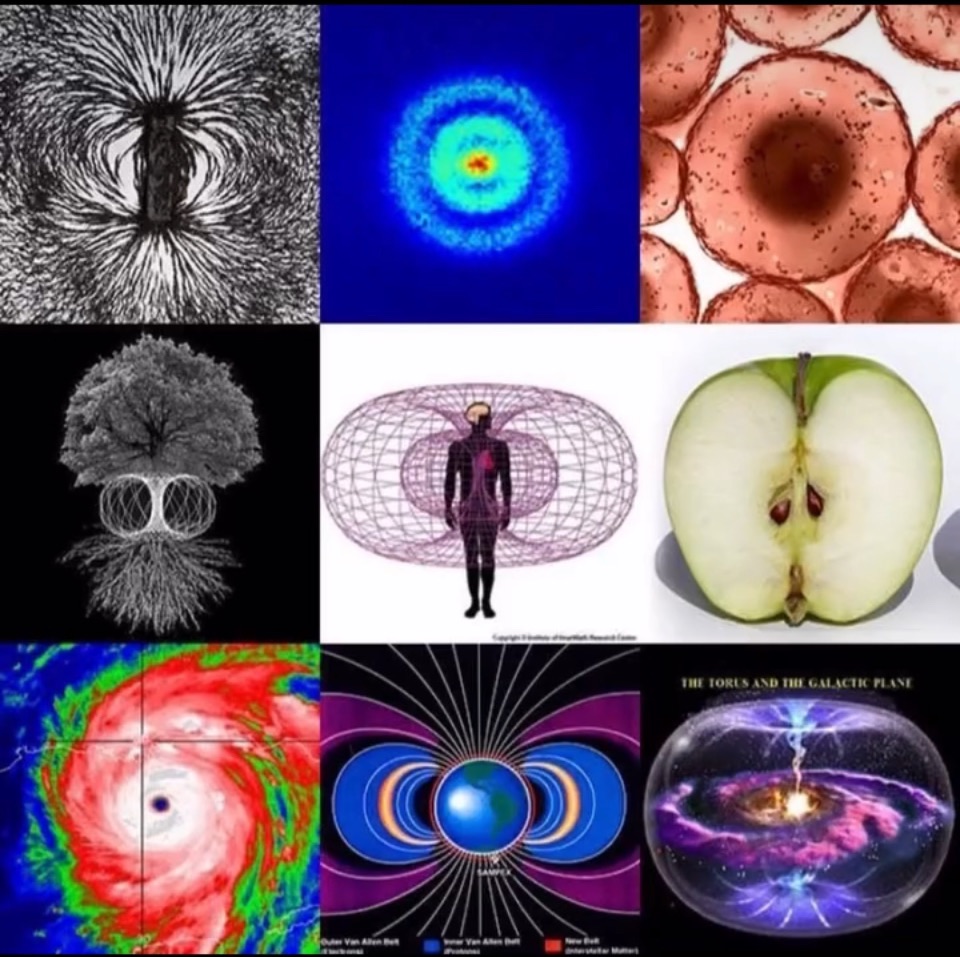
Physicist David Bohm described the universe as “an undivided wholeness in flowing movement,” which perfectly captures the toroidal dynamic. The torus facilitates continuous circulation—energy flowing out from a central point, expanding to its widest circumference, then recycling back through itself. This pattern creates remarkable efficiency through balanced, self-sustaining motion. NASA physicist Bernard Haisch noted that “the zero-point field is a vast reservoir of energy permanently present throughout the universe, its toroidal patterns creating the foundation of all matter.”
At the macro scale, galaxies like our Milky Way form massive spiral structures with toroidal magnetic fields. Earth itself generates a toroidal magnetic field that protects us from solar radiation. Hurricanes and cyclones demonstrate the same pattern, as seen in the weather visualization in the image. Even our own heart functions as a vortex pump, creating spiral flow patterns as blood moves through its chambers. Dr. Gerald Pollack’s research shows how water molecules in cells arrange themselves in coherent, geometrically ordered structures that facilitate energy transfer through toroidal patterns.
The torus appears throughout biology. Blood cells form perfect toroidal shapes to maximize surface area for oxygen transport. Trees grow in balanced above/below patterns that mirror each other, creating a toroidal energy field. When an apple is cut horizontally, its seeds form a five-pointed star pattern—a two-dimensional slice of its three-dimensional toroidal field. This pattern connects to the golden ratio (φ ≈ 1.618), which governs proportional growth throughout nature. As mathematician Roger Penrose observed, “There is a fundamental connection between geometric structures like the torus and the propagation of energy in space-time.”
The human biofield also follows toroidal patterns. Research from the HeartMath Institute demonstrates that the heart generates the body’s strongest electromagnetic field in a toroidal shape extending several feet from the body. This field entrains brain waves and affects cellular function throughout the body. Dr. James Oschman’s work in energy medicine shows how “the living matrix of the human body conducts energy in toroidal patterns that coordinate biological processes from the cellular to the systemic level.”
Ancient cultures intuited these patterns long before scientific confirmation. In Greek mythology, Gaia (Earth) emerged from Chaos as a self-organizing system. India’s concept of prana and China’s understanding of qi both describe life-force energy moving in toroidal flow patterns. The caduceus symbol—two intertwined serpents—represents these spiraling energy channels. The Rig Veda mentions “hiranyagarbha” (golden womb), which scholars interpret as describing a toroidal energy field from which physical reality emerges.
The phenomenon of sonoluminescence—where sound waves create imploding bubbles that produce light—demonstrates implosion physics in action. When water is subjected to specific sound frequencies, including those in the ancient Solfeggio scale (particularly 528 Hz, associated with DNA repair), energy concentrates through implosion. This connects to recent findings in quantum biology, where quantum effects like tunneling and coherence occur in biological systems despite the “noisy” cellular environment. As biophysicist Mae-Wan Ho stated, “The liquid crystalline nature of the cell allows quantum coherence to be maintained across the entire organism through toroidal energy patterns.”
DNA itself forms a double helix—essentially a two-dimensional slice of a toroidal field when viewed from certain angles. Mathematician Marko Rodin’s vortex-based mathematics suggests that numbers themselves follow toroidal patterns, with remarkable symmetries appearing when calculations are performed in base-10 modular arithmetic.
Biomimicry offers powerful applications of toroidal principles. For energy production, Viktor Schauberger’s implosion technologies demonstrated how spiral water flows can generate energy with minimal input. Modern vortex hydro plants are exploring these principles for clean energy generation. In agriculture, permaculture designs incorporate spiral patterns to maximize growing space and energy efficiency. Medical applications include research into toroidal magnetic fields for non-invasive healing, with studies showing their potential for accelerating cellular regeneration and reducing inflammation.
The practical applications of toroidal knowledge extend to daily life. You can:
- Cultivate awareness of cyclical patterns in your own body—breathing, circulation, and energy fluctuations—and work with these natural rhythms rather than against them.
- Design living and working spaces with circular flow patterns that mimic natural systems, enhancing energy efficiency and well-being.
- Practice heart-focused meditation techniques that strengthen your cardiac field’s toroidal coherence, shown to reduce stress and improve cognitive function.
- Explore sound healing with coherent frequencies that support cellular harmony.
- Study nature’s patterns through direct observation, strengthening your intuitive recognition of efficient design principles.
This knowledge calls us to reimagine our relationship with energy—both within ourselves and in our technologies. By aligning our innovations with nature’s toroidal efficiency, we can address environmental challenges while enhancing human health. The torus shows us that all systems thrive through balanced circulation, recycling, and coherent organization.
As physicist Nassim Haramein observed, “The structure of the vacuum of space is toroidal in nature, and when we align our technologies with this understanding, we tap into an essentially limitless reservoir of energy.” The ancients understood this wisdom; modern science confirms it; and our future depends on applying it. The spiral path forward invites us to recognize these patterns not just intellectually but to embody them in our lives and creations.
Toroidal Thinking: Challenging Dominant Systems and Charting New Possibilities
The toroidal perspective fundamentally challenges many dominant paradigms in our current socioeconomic and scientific frameworks. While linear thinking, hierarchical structures, and extractive economic models dominate our systems, the torus offers a cyclical, regenerative alternative that creates friction with established interests.
Conventional science still largely adheres to reductionist approaches, breaking systems into isolated components for study. This perspective has yielded tremendous technological advances but often misses emergent properties that arise from whole-system dynamics. As physicist Fritjof Capra noted, “The mechanistic worldview still provides the dominant framework for biological, social, and economic theories. But life itself is characterized by self-organization, circular networks, and intrinsic patterns that cannot be adequately captured through reductionism.” The torus model supports holistic sciences that recognize complexity, self-organization, and interconnection.
The linear economic paradigm of extract-produce-consume-discard directly conflicts with toroidal models of regeneration and circulation. Our financial systems prioritize indefinite growth on a finite planet—a mathematical and ecological impossibility that the circular patterns in nature never attempt. Political and corporate interests heavily invested in resource extraction and centralized energy production resist distributed, regenerative models that would disrupt these revenue streams. As economist Kate Raworth articulated in her “Doughnut Economics” model, “The goal of economic activity should be meeting the needs of all within the means of the planet… creating regenerative and distributive systems that function like nature’s own cycles.”
Centralized power structures, whether governmental or corporate, naturally resist the decentralized, self-organizing principles that toroidal systems represent. Modern medicine typically treats symptoms rather than systemic imbalances, while pharmaceutical interests have limited incentives to explore energy-based or preventative approaches. Educational institutions organized around standardization and linear progression struggle to incorporate cyclical learning models that honor individual development patterns.
To navigate these tensions constructively, toroidal thinking offers several approaches:
First, emphasize compatibility rather than replacement. Toroidal understanding enhances rather than invalidates the valuable contributions of linear thinking. For example, renewable energy systems can integrate with existing infrastructure while gradually transforming its fundamental nature. By positioning toroidal innovations as complementary technologies that enhance efficiency and sustainability, resistance may diminish.
Second, quantify benefits in terms recognized by current systems. While toroidal approaches often emphasize qualitative benefits, translating outcomes into economic metrics helps bridge understanding. When circular economy initiatives demonstrate cost savings, waste reduction, and new market opportunities, financial institutions take notice. The Ellen MacArthur Foundation has successfully used this approach to gain corporate support for circular economic models.
Third, build bridge concepts that connect paradigms. Biomimicry serves this function by demonstrating how natural patterns solve engineering challenges efficiently. As biomimicry expert Janine Benyus explains, “When we look at nature, we’re seeing the most beautiful, elegant solutions to scarcity, energy conservation, and compensation for change.” This framing appeals across ideological divides.
For raising consciousness and confidence in systems redesign, several practical approaches have proven effective:
Localized demonstration projects create tangible examples that build confidence. Community-scale initiatives—from local currencies to food forests to decentralized energy cooperatives—demonstrate toroidal principles functioning effectively. These living laboratories allow people to experience new paradigms directly, building confidence through participation rather than abstract theory.
Cross-disciplinary dialogues foster innovation where fields intersect. When architects collaborate with biologists, when economists engage with ecologists, novel approaches emerge that honor cyclical patterns. Organizations like the Buckminster Fuller Institute and the Bioneers network facilitate these exchanges by creating forums where diverse expertise can recombine.
Mainstream integration strategies help normalize these concepts. Companies like Interface Carpeting have demonstrated that circular manufacturing principles can achieve market success while reducing environmental impact. When regenerative approaches demonstrate economic viability, they gain credibility within current paradigms.
Education focused on pattern recognition rather than memorization helps develop systems thinking. Waldorf, Montessori, and other progressive educational models incorporate cyclical rhythms and natural patterns, producing graduates more comfortable with toroidal concepts. As these students enter professional fields, they bring these perspectives with them.
Importantly, toroidal thinking offers a path beyond polarization itself. As physicist Arthur Zajonc observed, “The torus reconciles apparent opposites—inner and outer, individual and collective, part and whole. It’s a geometry of both/and rather than either/or.” This integrative quality makes toroidal approaches particularly valuable in our politically divided landscape.
For individuals seeking to participate in this shift, begin by cultivating personal practices that strengthen your capacity for both/and thinking:
Develop cyclical awareness by tracking natural rhythms in your body, local ecosystem, and community. Regular observation of these patterns builds intuitive understanding of toroidal principles.
Practice collaborative rather than competitive approaches in your work and relationships, emphasizing how value can circulate rather than be extracted.
Seek opportunities to transform “waste” into resources, whether composting food scraps or repurposing materials that would otherwise be discarded.
Support organizations and businesses implementing regenerative models, using your consumer choices and investments to strengthen circular economies.
Engage in conversations that bridge rather than reinforce divisions, looking for shared values beneath apparent differences.
The shift toward toroidal systems thinking doesn’t require overthrowing existing structures so much as transforming them from within—much as a caterpillar reorganizes its cells to become a butterfly. By recognizing patterns that generate abundance through circulation rather than depletion through extraction, we can redesign systems to support both human and planetary thriving. As systems theorist Donella Meadows reminded us, “Vision is the most vital step in the policy process. If we don’t know where we want to go, it makes little difference that we make great progress.”
 Light Being ॐ
Leave a comment