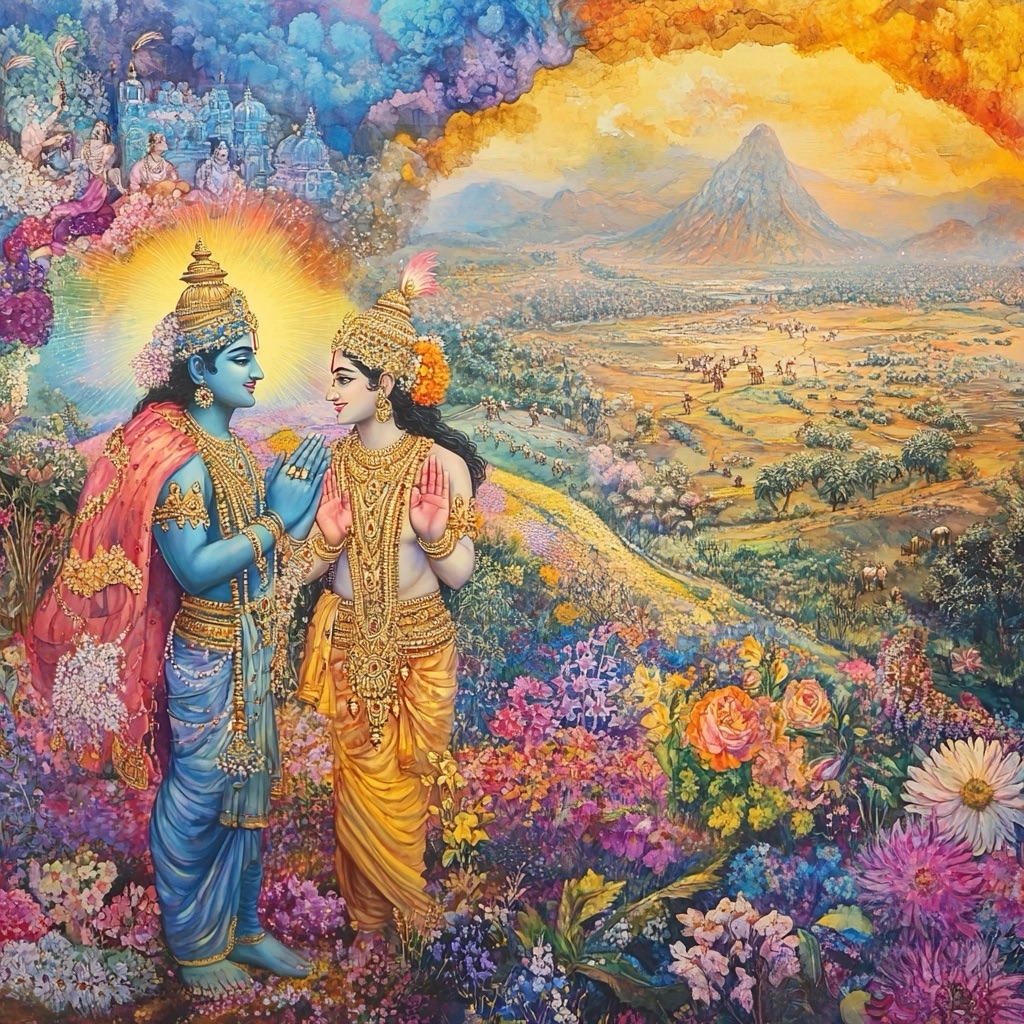
“The Essence of the Bhagavad Gita” by Paramahansa Yogananda represents one of the most profound and accessible interpretations of India’s beloved scripture.
Published posthumously as “God Talks with Arjuna: The Bhagavad Gita,” this monumental work transforms the ancient dialogue between Krishna and Arjuna into a living spiritual guide for modern seekers. Yogananda, the pioneering yogi who brought meditation to the West through his “Autobiography of a Yogi” and the founding of Self-Realization Fellowship, spent over twenty years developing this comprehensive commentary.
Unlike traditional interpretations that approach the text primarily through philosophical or theological lenses, Yogananda uniquely bridges Eastern spirituality with Western pragmatism, revealing the Gita’s teachings as universal principles that transcend cultural and religious boundaries.
His commentary uncovers the scripture’s deeper psychological and scientific dimensions, presenting spiritual truths not merely as beliefs to be accepted but as hypotheses to be tested through the laboratory of meditation and daily life.
For both newcomers to Eastern wisdom and seasoned practitioners, Yogananda’s interpretation offers a transformative journey through one of humanity’s most enduring spiritual classics, making its timeless guidance accessible and applicable to contemporary challenges.
Paramahansa Yogananda’s interpretation of the Bhagavad Gita, titled “God Talks with Arjuna: The Bhagavad Gita,” offers a profound spiritual examination of this ancient Hindu scripture.
Yogananda approaches the text not merely as a historical or philosophical document but as a metaphorical guide to inner spiritual warfare. He presents the battlefield of Kurukshetra as representing the human body and mind, where the struggle between positive and negative tendencies takes place.
The dialogue between Krishna (representing divine consciousness) and Arjuna (symbolizing the seeking soul) becomes a template for the spiritual journey toward self-realization.
Yogananda’s commentary emphasizes that the Gita’s essence lies in the balanced integration of four yoga paths: karma (selfless action), bhakti (devotion), jnana (wisdom), and raja (meditation). He illuminates how Krishna’s teachings guide the aspirant to perform actions without attachment to results, cultivate unwavering devotion to the Divine, develop discriminative wisdom to discern the eternal from the transient, and practice scientific meditation techniques to attain direct perception of truth.
Unlike many interpreters, Yogananda particularly highlights the scientific aspects of yoga meditation as the supreme method for God-realization.
Central to Yogananda’s interpretation is the concept of dharma—righteous action aligned with cosmic law—and how one must fulfill their duties with divine remembrance rather than escaping responsibilities. He explains Krishna’s famous teaching that the soul never dies but merely changes bodies, comparing this process to changing garments. Through his commentary, Yogananda reveals how the Gita offers practical solutions to life’s challenges while simultaneously providing the deepest metaphysical insights about the nature of consciousness, creation, and the ultimate reality.
Passages from the Bhagavad Gita
Yogananda’s commentary particularly illuminates Chapter 2, Verse 47, where Krishna instructs: “You have the right to work, but never to the fruit of work. You should never engage in action for the sake of reward, nor should you long for inaction.” This verse encapsulates the essence of Karma Yoga, which Yogananda interprets as the science of performing spiritualized action. He explains that this teaching doesn’t advocate indifference to results but rather freedom from the bondage of attachment to outcomes, allowing one to remain equanimous in success and failure alike.
In Chapter 6, Verse 10, Krishna describes meditation: “The yogi should constantly engage himself in yoga, staying in a secluded place, alone, with mind and body controlled, free from desires and possessions.” Yogananda elaborates on this verse by providing detailed explanations of meditation techniques, particularly emphasizing the spine-centered practice of Kriya Yoga, which he brought to the West. He interprets the “secluded place” as not merely a physical location but also the withdrawal of consciousness from external stimuli.
Chapter 9, Verse 22 offers a profound promise of divine care: “Those who worship Me with devotion, meditating on My transcendental form—to them I carry what they lack and preserve what they have.” Yogananda explains this as Krishna’s covenant with devotees, assuring that sincere spiritual aspirants will always receive divine support for both material necessities and spiritual advancement when they make God the primary focus of their lives.
One of the most powerful passages Yogananda elaborates upon is Chapter 11, where Arjuna witnesses Krishna’s cosmic form. In Verse 32, Krishna declares: “Time I am, destroyer of worlds.” Yogananda interprets this revelation as the cosmic law of cycles operating throughout creation, showing how everything in the universe—from atoms to galaxies—follows rhythmic patterns of manifestation and dissolution.
Chapter 12, Verse 8 provides guidance on devotion: “Just fix your mind upon Me, the Supreme Personality of Godhead, and engage all your intelligence in Me. Thus you will live in Me always, without a doubt.” Yogananda explains this as the essence of Bhakti Yoga, emphasizing that true devotion isn’t blind faith but the continuous attunement of consciousness with divine consciousness through both feeling and understanding.
In his commentary on Chapter 13, Verse 34: “As the sun alone illuminates all this universe, so does the living entity, one within the body, illuminate the entire body by consciousness,” Yogananda offers insights into the relationship between individual consciousness and cosmic consciousness. He explains how the soul’s light animates the body much as God’s consciousness permeates creation.
Chapter 15, Verse 15 contains a profound metaphysical truth: “I am seated in everyone’s heart, and from Me come remembrance, knowledge and forgetfulness.” Yogananda describes this as revealing God’s immanent presence as the divine memory and intelligence functioning within all beings, orchestrating both the soul’s bondage and its eventual liberation.
Finally, in Chapter 18, Verse 66, Krishna gives his ultimate instruction: “Abandon all varieties of dharma and just surrender unto Me. I shall deliver you from all sinful reactions. Do not fear.” Yogananda interprets this not as a dismissal of righteous living but as an invitation to transcend rule-bound religiosity and enter into direct, personal communion with God through meditation, where perfect love dissolves all fear and karma.
The Value of Yogananda’s “The Essence of the Bhagavad Gita” in Current Times
Yogananda’s interpretation of the Bhagavad Gita holds remarkable relevance for contemporary society, offering profound guidance for navigating the complexities and challenges of modern life. In our era characterized by constant distraction, digital overstimulation, and widespread anxiety, his emphasis on meditation as a scientific approach to inner peace provides a practical antidote to the mental health crisis affecting millions worldwide. The Gita’s teachings on maintaining equanimity amidst life’s inevitable ups and downs—which Yogananda explains through accessible metaphors and examples—offer a psychological resilience toolkit that complements modern therapeutic approaches.
In today’s workplace environments where burnout has become epidemic, Yogananda’s elaboration on Karma Yoga—performing action with right attitude while remaining detached from outcomes—provides a transformative approach to professional life. His commentary helps readers understand how to maintain inner calm while fully engaging with demanding careers, showing that spiritual practice doesn’t require withdrawal from active life but rather a transformation of one’s approach to action. This reframing of work as worship speaks directly to contemporary seekers struggling to balance material responsibilities with spiritual aspirations.
Amidst growing environmental concerns, Yogananda’s interpretation of the Gita’s cosmology—highlighting the interconnectedness of all creation—reinforces ecological consciousness. His explanation of how Krishna reveals himself through nature encourages readers to develop reverence for the environment as a manifestation of divine intelligence. Similarly, in our polarized sociopolitical landscape, the Gita’s emphasis on seeing the same divine essence in all beings, regardless of external differences—which Yogananda explains through both spiritual insights and scientific parallels—offers a foundation for unity consciousness that transcends divisive ideologies.
Perhaps most significantly for our materialistic age, Yogananda’s commentary addresses the emptiness many feel despite material abundance. By explaining how the Gita distinguishes between transient pleasures and enduring happiness, he provides a roadmap for authentic fulfillment that doesn’t depend on external circumstances. His practical techniques for experiencing inner joy through meditation offer an experiential alternative to consumption-based definitions of success that dominate contemporary culture.
For spiritual seekers confused by the marketplace of religious and philosophical options, Yogananda’s universal interpretation of the Gita—drawing parallels with Christian, Sufi, and other traditions while maintaining respect for its Hindu roots—demonstrates how ancient wisdom transcends cultural boundaries. This inclusive approach resonates with the growing number of people who identify as “spiritual but not religious,” offering depth without dogmatism and tradition without fundamentalism.
Ultimately, in an age increasingly dominated by artificial intelligence and technological solutions, Yogananda’s emphasis on developing intuitive wisdom through meditation reminds us of the uniquely human capacity for self-awareness and spiritual insight. His commentary on the Gita affirms that despite our technological advances, the ancient quest to know ourselves remains our most profound journey—one that no external innovation can accomplish for us.
https://yogananda.com.au/gita00.html
 Light Being ॐ
Leave a comment