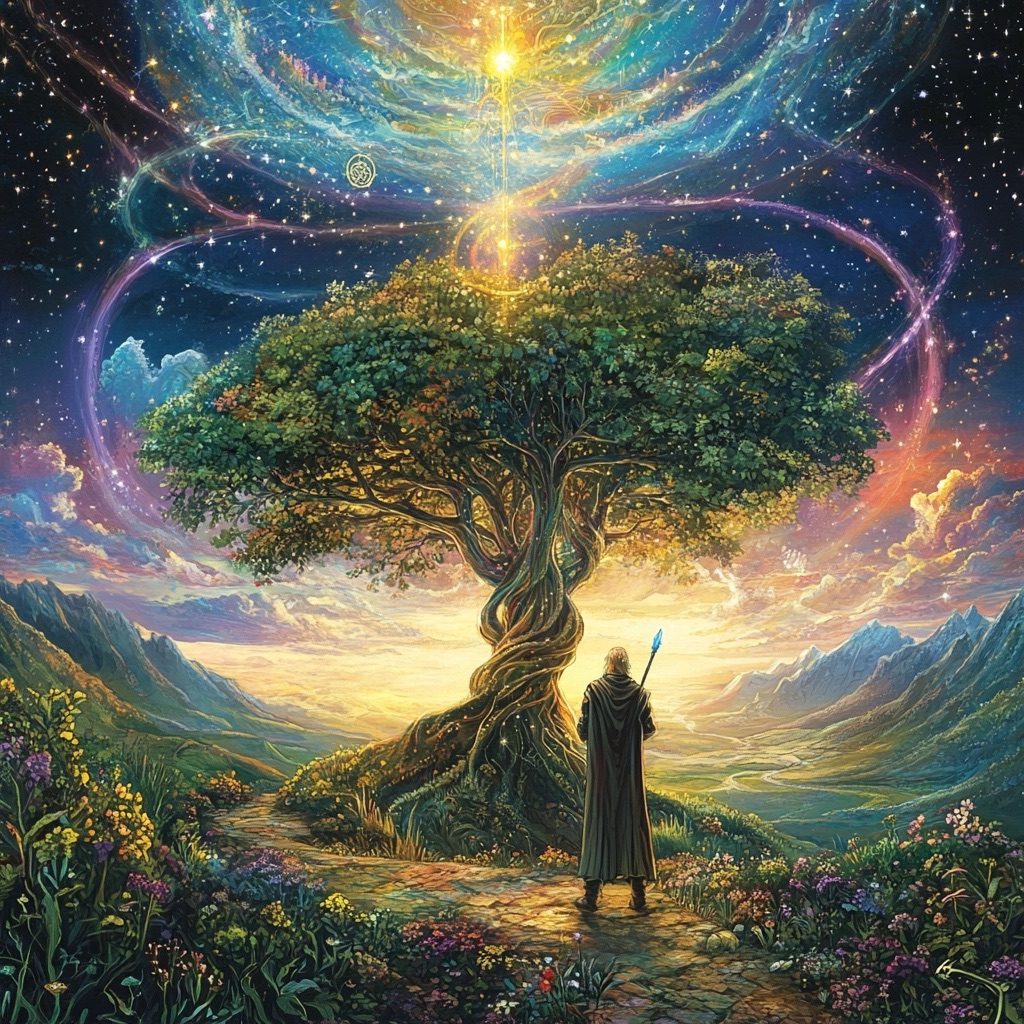
In the heart of Norse cosmology stands Yggdrasil, the World Ash—a cosmic axis connecting nine realms of existence. This is not mere mythology but an ancient symbolic system for understanding reality’s interconnected nature. Modern ecological science recognizes trees as network organisms, their mycorrhizal associations forming underground neural-like networks that share resources and information across forest communities. Similarly, Yggdrasil represents the fundamental interconnectedness of all existence—a concept quantum physics has rediscovered through entanglement and non-locality.
At the roots of Yggdrasil lies Mímisbrunnr, the Well of Memory, where all knowledge past and future flows. The serpent Níðhöggr gnaws continuously at these roots—entropy’s eternal work against the organized structure of knowledge. Above, the eagle Hræsvelgr beats its wings, creating the winds of change that flow through all realms.
The Sacrifice
In the primordial time of the cosmos, Odin—the wanderer, the seeker, the god of wisdom and war—came to understand a profound truth: true wisdom requires sacrifice. Knowledge gained without cost holds little transformative power.
On a windswept day beneath iron-gray skies, Odin approached the great ash. He carried his spear Gungnir, its shaft carved with binding runes. With deliberate movements, he prepared for what neuroscience might now recognize as a self-induced altered state of consciousness—a controlled disruption of normal neural patterns to access deeper mental processes.
“I give myself to myself,” he proclaimed, piercing his side with his own spear—establishing the physical stress that would trigger his brain’s survival mechanisms and open pathways between conscious and unconscious processing.
He fastened a rope around his body and suspended himself from a branch of Yggdrasil. For nine days and nights—a symbolically complete cycle—he hung between life and death, between consciousness and unconsciousness, in what anthropologists recognize as the universal liminal space of transformative ritual.
No food passed his lips. No water quenched his thirst. His physical systems began to shut down—metabolism slowed, consciousness altered, brain chemistry shifted toward the hallucinogenic as ketones replaced glucose. What neurologists might identify as hypoxia-induced altered consciousness, the Norse understood as sacred trance.
His body weakened. His breath grew shallow. His one remaining eye—the other already sacrificed for a drink from Mimir’s well of wisdom—gazed downward into the abyss of possibility.
The Revelation
On the ninth night, as his consciousness hovered at the threshold between worlds, Odin perceived patterns emerging from the swirling chaos below—patterns that contained the fundamental structure of reality itself. Modern cognitive science understands that pattern recognition forms the basis of human meaning-making; what Odin experienced was the deepest form of this innate capacity.
With a final surge of effort—what psychologists would identify as the integration of unconscious material into conscious awareness—Odin “seized” these patterns. They were the runes, sixteen sacred symbols containing the phonetic and conceptual building blocks of language and reality.
Each rune embodied not just a sound but a principle: Fehu (wealth/energy), Uruz (primal strength), Thurisaz (chaos/catalyst), Ansuz (divine communication), Raidho (journey/rhythm), and so on—a complete system of symbolic understanding that mapped onto both language and deeper reality.
As he grasped this knowledge, Odin released a primal cry—both death rattle and birth announcement. His consciousness expanded as neurochemical cascades rewired his divine brain. He had died to his old self and was reborn with the fundamental codes of creation integrated into his being.
The Integration
When Odin returned to consciousness, he possessed something beyond mere information. Neuroplasticity had permanently altered his cognitive structure. The runes were not simply memorized but embodied—integrated into his very being through the neurological restructuring that accompanies profound learning experiences.
The runes became his tools for world-shaping. With them, he could bind and loose, create and destroy, heal and harm. This reflects the profound truth that language does not merely describe reality but participates in constructing it—what linguistic anthropologists call the performative aspect of language, and what quantum physics suggests through the observer effect.
Modern neuroscience confirms what the myth intuitively understood: language shapes perception by creating cognitive frameworks that filter experience. The runes represent the most fundamental of these frameworks—the deep structure beneath all manifestation.
The Scientific and Mythic Convergence
This mythic narrative contains profound psychological insight. The voluntary confrontation with death—what Jung called “necessary suffering”—parallels modern therapeutic approaches that recognize the necessity of confronting shadow material for psychological integration.
The nine-day ordeal exemplifies what neuroscience now understands about stress hormones and neuroplasticity—moderate to severe stress can trigger enhanced learning and memory formation, permanently altering neural pathways when combined with profound meaning.
Odin’s sacrifice illustrates the universal pattern of transformation that anthropologist Victor Turner identified in all human societies: separation from normal reality, liminal experience at the threshold of chaos, and reintegration with expanded consciousness.
The Living Legacy
What Odin discovered through his ordeal was that language—specifically written language—represents more than communication. It is a technology for consciousness itself. Each rune became a condensed algorithm of meaning, capable of expanding into complete understanding when properly engaged.
The runes spread throughout the nine worlds and eventually to humanity. They became tools of divination, healing, magic, and poetry—technologies for navigating both inner and outer reality. What cognitive scientists call “symbolic thinking” emerged as the greatest gift of consciousness.
The poet who shapes words, the scientist who formulates equations, the programmer who writes code—all are heirs to Odin’s discovery that reality can be represented, manipulated, and even created through symbolic systems.
In this ancient story, we see a profound understanding that modern science continues to validate: consciousness, language, and reality exist in dynamic relationship. Through sacrificing the limited self, we gain access to deeper patterns of meaning and creation. Through disciplined suffering—what psychologists might call “deliberate practice” and “controlled exposure”—we develop capacities beyond our previous limitations.
Odin’s journey reminds us that the greatest wisdom comes at a price—the willingness to suspend our ordinary consciousness, to hang between worlds, to embrace uncertainty, and to die to who we have been so that we might be reborn into who we might become.
The runes continue to whisper their mysteries, reminding us that language is not just a tool for describing the world, but the fundamental code through which consciousness itself participates in the ongoing creation of reality.
 Light Being ॐ
Leave a comment