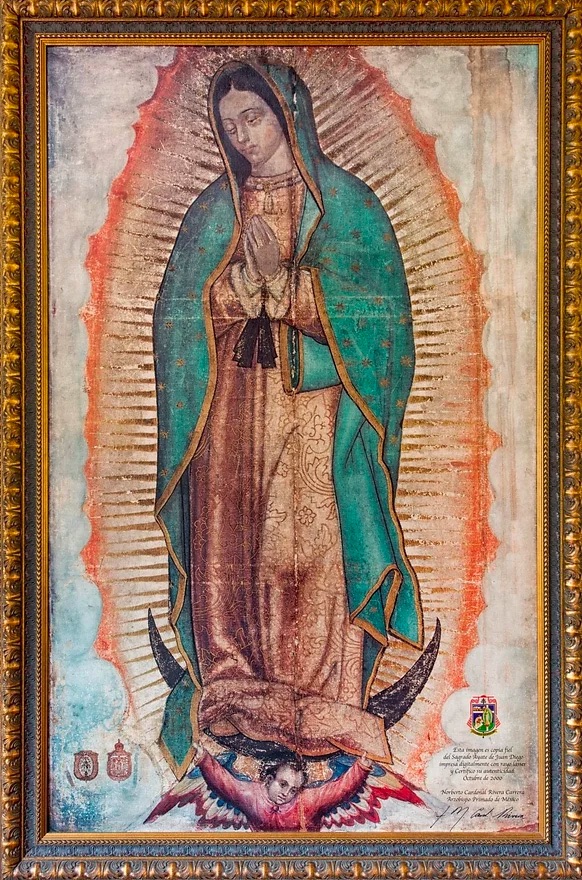
The mystery of Our Lady of Guadalupe remains one of the most captivating and enduring enigmas in religious history, blending faith, science, and unexplained phenomena in ways that continue to puzzle researchers and believers alike.
The story begins in December 1531, when an indigenous man named Juan Diego reported seeing a vision of the Virgin Mary on Tepeyac Hill, just outside what is now Mexico City. According to tradition, the apparition spoke to him in his native Nahuatl language and asked for a church to be built on that site. When the local bishop demanded proof, Juan Diego returned to the hill, where the Virgin instructed him to gather roses—miraculous in themselves, as roses didn’t grow on the rocky hill in December. Even more remarkably, when Juan Diego opened his tilma (a cactus-fiber cloak) before the bishop to present the roses, an image of the Virgin had appeared on the fabric.
What transforms this from a religious account into an enduring mystery are the extraordinary characteristics of the image itself. The tilma, made from maguey cactus fibers, should have deteriorated within decades under normal circumstances, yet it has remained intact for nearly 500 years. Scientific analysis has revealed puzzling properties: the image appears to have no underlying sketch or preparatory work, the pigments don’t correspond to any known materials from that era, and certain details seem to change depending on the viewing distance and angle.
Perhaps most intriguingly, ophthalmological studies of the Virgin’s eyes in the 1950s revealed what appear to be human figures reflected in the pupils—possibly depicting the moment when Juan Diego opened his tilma before the bishop and witnesses. The reflections follow the natural curvature and physics of how images would appear in human eyes, a level of optical sophistication that would have been impossible to achieve with 16th-century artistic techniques.
The image also contains rich symbolic elements that speak to both indigenous and Spanish cultures. The Virgin appears with indigenous features, wearing a star-covered mantle that mirrors Aztec depictions of the cosmos, yet she also bears Christian symbolism. This cultural fusion helped facilitate the conversion of millions of indigenous people to Christianity, making the image not just a religious icon but a pivotal force in Mexican history and identity.
Modern scientific investigations have yielded contradictory and puzzling results. Some researchers claim the image shows properties inconsistent with human artistic creation, while others argue that careful analysis reveals conventional painting techniques. Infrared photography has detected what might be preparatory sketches in some areas, yet other regions show no such underlying work. The fabric’s preservation remains unexplained by conventional means, though some propose that the specific environmental conditions of its housing may have contributed to its longevity.
The mystery deepens when considering the historical context. The apparition occurred at a crucial moment in Mexican history, just a decade after the Spanish conquest, when indigenous peoples were struggling with the destruction of their traditional religious systems. The image of Guadalupe provided a bridge between worlds, incorporating familiar indigenous symbols while introducing Christian elements, suggesting either divine intervention perfectly timed for maximum cultural impact or an extraordinarily sophisticated understanding of religious psychology.
Today, the tilma hangs in the Basilica of Our Lady of Guadalupe in Mexico City, where millions of pilgrims visit annually. Despite extensive scientific study, definitive explanations for the image’s origin, composition, and preservation remain elusive. Whether viewed as a miraculous sign, an unexplained artistic achievement, or a combination of factors not yet understood, Our Lady of Guadalupe continues to challenge our understanding of the intersection between faith, history, and science.
The enduring mystery lies not just in the physical properties of the image, but in its profound impact on culture, religion, and human experience across nearly five centuries—an influence that seems disproportionate to its humble origins, adding yet another layer to one of the world’s most compelling unsolved puzzles.
Details about the Tilma
Preservation:
- Maguey cactus fiber should decay within 20-30 years
- Nearly 500 years old, minimal deterioration
- No protective coating or treatment until modern times
- Survived floods, candle smoke, touching by millions
Pigments:
- No identifiable binding agent found
- Colors appear to penetrate fibers rather than sit on surface
- Some areas show no pigment at all – image appears to be the fabric itself
- Spectroscopic analysis inconclusive on material composition
Eye Reflections:
- 1950s ophthalmological studies found human figures in pupils
- 13 people allegedly visible in both eyes
- Reflections follow Purkinje-Sanson effect (proper optical physics)
- Images appear at correct size/position for human eye reflections
- Scene possibly depicts Juan Diego’s presentation to Bishop Zumarraga
Astronomical Elements:
- Star pattern on mantle matches 1531 winter solstice sky over Mexico
- 46 stars correspond to actual constellation positions
- Arrangement significant to Aztec cosmology
- Virgin positioned as “Woman clothed with the sun” (Revelation 12:1)
Physical Properties:
- No brush strokes detected in many areas
- No preparatory sketches found (though some disputed)
- Image appears three-dimensional from certain distances
- Temperature consistently 98.6°F (human body temperature)
- Fabric remains flexible despite age
Cultural Coding:
- Aztec symbols: pregnancy sash, star mantle, moon position
- Face appears indigenous to native viewers, European to Spanish
- Hands positioned in Aztec prayer position
- Flowers on dress match indigenous sacred symbols
Unexplained Phenomena:
- Survived 1921 bomb blast (damaged altar, tilma untouched)
- No fading despite centuries of candle smoke exposure
- Image changes appearance based on viewing distance
- Some areas transparent, others opaque without explanation
Sacred Symbols in Prayer:
- Roses: “Send me roses as a sign”
- Stars: “Crown me with stars”
- Tilma: “Wrap me in your protection”
- Tepeyac: “Holy hill of encounter”
Prayer to Our Lady of Guadalupe: “Holy Mary of Guadalupe, Mystical Rose, intercede for the Church, protect the Holy Father, and help all who invoke you in their necessities. Since you are the ever-virgin Mary and Mother of the true God, obtain for us from your most holy Son the grace of keeping our faith, sweet hope in the midst of the bitterness of life, burning charity, and the precious gift of final perseverance. Amen.”
Juan Diego’s Prayer (Traditional): “My Lady, my Queen, my Little Girl, I am your servant. You have given me the task of going to your Bishop. I am a simple man, not worthy of the place you are sending me. But I will go and give your message.”
The Guadalupe Rosary Mysteries
The Guadalupe Rosary presents a unique devotional practice that transforms the traditional rosary structure to focus specifically on the four apparitions of Our Lady of Guadalupe to Juan Diego in December 1531. This specialized rosary allows the faithful to meditate deeply on each encounter while maintaining the familiar rhythm of Hail Marys, Our Fathers, and Glory Be prayers.
Structure and Practice:
Unlike the traditional rosary with its five decades, the Guadalupe Rosary typically follows a four-decade format corresponding to the four apparitions. Some versions include a fifth decade for the miracle of the roses and the image appearing on the tilma. Each decade begins with an Our Father, followed by ten Hail Marys while meditating on the specific apparition, and concludes with a Glory Be and often a special Guadalupe prayer.
The Four Mysteries:
First Mystery – The First Apparition (December 9, 1531): Juan Diego encounters the beautiful Lady on Tepeyac Hill while walking to Mass. She speaks to him in Nahuatl, calling him “Juanito” and “my little son,” requesting that a temple be built on the hill so she can show her love and compassion to all people. Meditation focuses on Mary’s maternal tenderness, her respect for indigenous culture, and her desire to be close to the humble and poor.
Second Mystery – The Second Apparition (December 10, 1531): Juan Diego returns from his unsuccessful meeting with Bishop Zumárraga, feeling inadequate for the task. The Virgin listens with compassion and insists that he, specifically, must be her messenger. She reassures him of his worth and her protection. This mystery emphasizes Mary’s confidence in the humble, God’s choice of the lowly to confound the mighty, and the importance of perseverance in faith.
Third Mystery – The Third Apparition (December 11, 1531): Juan Diego attempts to avoid the Virgin while rushing to get a priest for his dying uncle, Juan Bernardino. The Virgin appears to him anyway, gently questioning his worry and reminding him that she is his mother and protector. She assures him his uncle is already healed. This mystery focuses on Mary’s understanding of human weakness, her healing power, and her reminder that nothing should cause anxiety for those under her protection.
Fourth Mystery – The Fourth Apparition (December 12, 1531): The Virgin sends Juan Diego to gather roses from the barren hilltop in winter. When he opens his tilma before the bishop, the miraculous image appears. This mystery celebrates the power of obedience, the beauty of God’s unexpected gifts, and the transformation of simple faith into miraculous witness.
Variations and Additional Mysteries:
Some versions include a Fifth Mystery focusing on the aftermath: the healing of Juan Bernardino, the building of the first chapel, and the millions of conversions that followed. Others incorporate the Mystery of the Tilma’s Preservation through the centuries.
Meditative Themes:
Each mystery invites reflection on key spiritual themes: Mary’s preferential love for the poor and marginalized, the dignity of indigenous peoples, the power of maternal intercession, the importance of cultural sensitivity in evangelization, and the ongoing relevance of Guadalupe’s message of hope and healing.
Santa María de Guadalupe, ruega por nosotros.
 Light Being ॐ
Leave a comment